
AI’s Exponential Growth and Impact
AI is experiencing exponential growth. In 2017, only 20% of companies had adopted AI in at least one business area; by 2022 that figure jumped to 50%. This surge has propelled AI from a niche experiment to a core strategic priority. According to PwC, AI could contribute up to $15.7 trillion to the global economy by 2030 – that’s a 14% boost, more than the current output of China and India combined. The UK stands to gain significantly: AI is projected to raise UK GDP by 10.3% (an extra £232 billion) by 2030. Such numbers underscore why analysts call AI the biggest commercial opportunity of our time. Business leaders are taking note – what was once “future tech” is now a present-day competitive imperative.
Rapid AI Deployment Across All Sectors
The speed of AI deployment is breathtaking, permeating every industry from finance to healthcare. In finance, nearly all major institutions have integrated AI – the Bank of England reports that 95% of insurance firms and 94% of banks are already using AI for tasks like risk analysis and fraud detection. Healthcare is adopting AI for diagnostics and drug discovery; over three-quarters of NHS staff support using AI in patient care. Manufacturing floors are being transformed by AI-driven robots and predictive maintenance systems, boosting efficiency and output. Even in marketing and retail, AI is revolutionizing operations: 47% of marketers now trust AI for tasks like ad targeting, and nearly 50% of UK B2C firms are experimenting with AI in e-commerce. At a national level, UK AI adoption, while still growing, shows a clear trend: 30% of IT and legal firms, 17% of manufacturers, and 12% of retail/hospitality companies have already adopted AI tech. Analysts forecast these numbers will climb rapidly each year. The takeaway: AI is no longer confined to tech startups – it’s being deployed right now in every sector, across businesses large and small, radically accelerating innovation.
AI could boost the United Kingdom’s economy by an extra £232 billion by 2030. As the figure above illustrates, AI’s potential economic impact is enormous. In fact, by automating processes and enabling new products and services, AI is expected to make the UK economy 10.3% larger in 2030 than it would be otherwise. Every region – from England to Wales, Scotland and Northern Ireland – stands to benefit from these productivity gains. This kind of transformative growth is comparable to the Industrial Revolution, but unfolding at digital speed in just a few years instead of decades.
Gaining a Competitive Edge with AI
Early adopters of AI are already leapfrogging their competition. Companies implementing AI solutions are seeing measurable boosts in productivity, efficiency, and revenue. A recent UK government survey found that firms embracing modern technologies (like AI) enjoyed 19% higher turnover per employee on average – a clear productivity uplift. Globally, 63% of businesses reported revenue growth in areas where they applied AI. Smaller companies are also reaping rewards: 91% of AI-powered SMBs say AI has boosted their revenue. These gains come from AI’s ability to streamline workflows (e.g. automating routine tasks), uncover insights in massive data sets, and enhance customer experiences around the clock. For example, AI chatbots can handle customer queries 24/7, and AI-driven analytics can optimize supply chain and inventory far faster than manual methods. The competitive advantage is tangible – higher output, lower costs, happier customers – and it’s widening the gap between innovators and laggards. McKinsey observes that the “AI elite” (companies attributing 20%+ of their earnings to AI) are pulling ahead by investing more and achieving higher returns, leaving others behind. In short, those who leverage AI now are the ones setting the pace in their industries.
The Cost of Inaction: Risks of Not Adopting AI
On the flip side, failure to adopt AI poses a serious risk. Businesses that ignore this revolution risk falling irreversibly behind their competitors. As AI-driven firms innovate and cut costs, those clinging to legacy practices will find it harder to compete on price, quality, and speed. Economic analysis in the UK warns that the growing productivity gap between the top firms and the rest is partly due to tech adoption differences – in other words, companies not utilizing AI and modern tech are being left in the dust. The window of opportunity is closing fast, as the World Economic Forum cautions. Already, 4 in 5 executives globally are accelerating automation plans. If your business isn’t keeping up, it could face lost market share, shrinking margins, and an inability to meet customer expectations that have been elevated by AI-enhanced services (for instance, ultra-personalized product recommendations or lightning-fast loan approvals). There’s also a macro risk: non-adoption could mean broader economic stagnation for regions or industries that lag, as more agile players capture the growth. The message is clear – inaction on AI is perhaps the biggest risk of all. Companies that wait too long may find that it’s too late to catch up, as early adopters lock in their advantages.
Workforce Disruption & Transformation
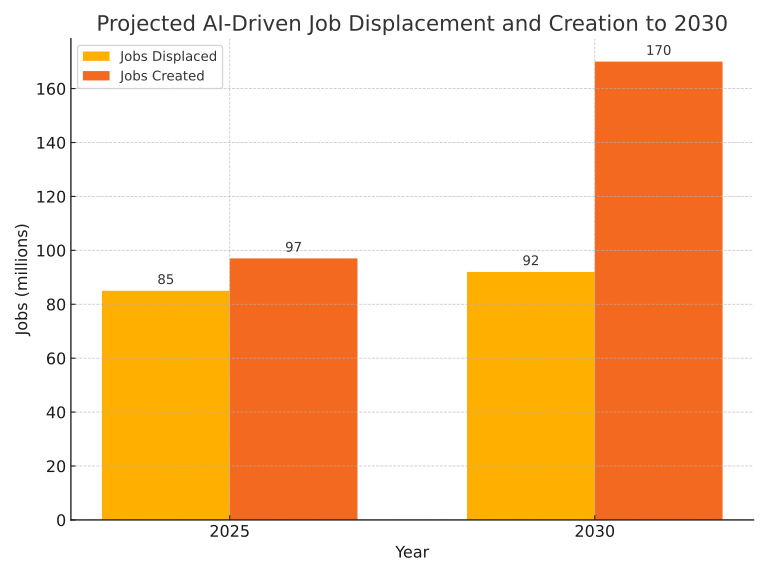
AI’s rise is transforming the workforce at all skill levels. It’s not just factory or clerical jobs at stake; increasingly, knowledge work is being reshaped by AI. Automation and AI are expected to disrupt 85 million jobs globally by 2025, displacing roles in data entry, accounting, customer service, and beyond. At the same time, 97 million new roles requiring AI skills may emerge by 2025 – think AI trainers, data scientists, and tech-enabled creatives. By 2030 this trend accelerates: the latest Future of Jobs report projects 92 million jobs will be displaced and 170 million created (a net +78 million) as AI and automation restructure industries. Crucially, both low- and high-skill jobs are affected. AI can drive a truck or assemble widgets, but it can also draft legal contracts, write software code, or diagnose illnesses by analyzing medical scans. Goldman Sachs estimates that two-thirds of current jobs could be at least partly automated by AI, with up to 300 million full-time roles worldwide potentially impacted. This doesn’t mean mass unemployment – rather, roles will evolve and new jobs will appear – but it does mean every employee from the warehouse to the boardroom will need to adapt. Approximately 40% of all workers will need reskilling within the next five years as AI changes skill requirements. Forward-looking businesses are already investing in retraining their staff to work alongside AI. The takeaway for decision-makers is that AI is a powerful force for change in the workforce: embracing it means preparing your people for new ways of working, while resisting it could leave your organization with an outdated skill set and talent flight.
A Societal Shift – Faster Than the Industrial Revolution
Make no mistake: we are living through a pivotal societal shift. Many compare the AI revolution to the Industrial Revolution in its scale – but note that AI’s impact is unfolding much faster. The Industrial Revolution took decades to transform industries; AI is achieving similar feats in a matter of years. This brings both huge opportunities and challenges. On the positive side, AI could dramatically boost productivity and economic growth. Goldman Sachs predicts generative AI alone could lift global GDP by 7% (nearly $7 trillion) over the next decade. We’re already seeing AI help develop life-saving medicines, reduce waste in supply chains, and provide personalized education at scale. AI-driven growth could raise living standards and create entirely new markets and professions. However, like past revolutions, there are potential downsides to navigate. Job displacement and the need for retraining on a massive scale could exacerbate short-term inequality if not addressed. There are also concerns around ethical use of AI, data privacy, and ensuring AI decision-making is fair and transparent. Society will need to adjust to humans and intelligent machines working side by side. But history shows that technological revolutions ultimately increase employment and prosperity in the long run – over 85% of job growth in the past 80 years has come from new roles created by technology. The AI revolution, if managed well, promises a better quality of life and work. It’s a double-edged sword: businesses and governments must maximize AI’s benefits (productivity, innovation, convenience) while mitigating the risks (displacement, bias, disruption). In sum, AI represents a turning point for society on par with the steam engine or electricity – and it’s happening at a blistering pace.
Projections and Ripple Effects: What’s Next?
In the short term (next 1–3 years), expect AI adoption to become nearly ubiquitous. Analysts predict that by 2025, over 80% of enterprises will have integrated AI in some form, especially with the rapid rise of generative AI tools. The year 2024 already saw an explosion of generative AI use, with one-third of companies regularly using gen AI just months after its debut. This will ripple through supply chains and partner networks – if your suppliers or clients use AI, they will expect you to do the same for seamless integration. Autonomous agents, AI-driven forecasting, and real-time analytics are poised to streamline operations from procurement to customer service. For example, AI can instantly adjust supply chain logistics in response to real-time demand or disruptions, something human planning struggles to match.
In the long term (by 2030), the transformations multiply. Experts project the global AI market to grow from about $450 billion in 2022 to over $2.5 trillion by 2032, underpinning a vast array of applications in every field. Entire industries will be reshaped: smart factories with lights-out (fully automated) manufacturing, AI-optimized energy grids, and personalized AI assistants in daily life. Supply chains in particular will be revolutionized – the market for AI in supply chain management is forecast to jump from $9.2 billion in 2024 to $40.5 billion by 2030 as firms leverage AI for demand forecasting, inventory management, and logistics optimization. This means leaner inventories, fewer stock-outs, and faster delivery across industries from retail to automotive. We will also see AI’s effects radiate into connected industries: increased automation in transportation (self-driving vehicles, AI-dispatch systems), smarter agriculture (AI-driven robots and crop analytics), and more efficient construction and infrastructure maintenance through AI monitoring. By 2030, AI could be as commonplace in business as computers and the internet – an assumed part of every process. Crucially, those projections also include new jobs and industries emerging to support and augment AI – from AI ethicists to maintenance of AI-driven machines – creating an ecosystem of innovation. The ripple effects of today’s AI investments will be felt for decades, transforming value chains and requiring every company to evolve. The bottom line: the sooner organizations adopt and learn to ride this wave, the better positioned they will be in the AI-driven economy of the very near future.
Act Now: Embrace AI or Be Left Behind
AI is not a distant prospect – it’s here now, reshaping business at lightning speed. For UK businesses and decision-makers, the mandate is clear: act now to harness AI’s potential or risk obsolescence. This is a call to action to start your AI journey today. By partnering with experts and leveraging ready-made solutions, even firms without in-house AI teams can quickly get up to speed. Our agency specializes in delivering practical, results-driven AI solutions to help you stay ahead of the curve. We offer a suite of services designed to drive growth, efficiency, and customer engagement through AI, including:
- AI Voice Calling Agents – automated agents that handle phone inquiries and outreach with human-like conversation skills.
- AI Chatbots & Virtual Assistants – 24/7 chat support on your website or apps to instantly assist customers and free up your team.
- AI Agents for WhatsApp, Instagram, Telegram & X – intelligent bots to manage messaging on social platforms and messaging apps, engaging your audience wherever they are.
- Mass AI-Powered Email Outreach – personalize and scale your email marketing with AI that crafts tailored messages and optimizes send times for maximum impact.
- AI Content Creation (Text, Image, Video, Audio) – generate high-quality content at scale, from blog posts and social media visuals to product videos and podcasts, all powered by cutting-edge generative AI.
- AI Personalities for X (Twitter) – unique AI-driven personas that can interact on X, boosting your social presence and engaging followers in novel ways.
- ChatGPT & Generative AI Automation – custom automation of internal or customer-facing processes using ChatGPT and other generative AI, from drafting reports to answering FAQs.
- Social Media Management – AI-assisted tools to analyze trends, optimize posting schedules, and manage your brand’s reputation across platforms proactively.
- Bespoke AI Solutions – end-to-end tailored AI development to address your specific business challenges, whether it’s predictive analytics, recommendation engines, or process automation.
Investing in these AI solutions now will position your business to innovate faster, operate leaner, and delight customers in ways that were impossible just a few years ago. The AI revolution is accelerating by the day – don’t be the company stuck in neutral while your competitors race ahead. By embracing AI today, you’re not just adopting a new technology, you’re future-proofing your business for the new era. The time to act is now: let us help you ride the wave of AI’s rise and secure your place among the winners of this new industrial revolution.
Sources: McKinsey Global Surveys on AI; PwC UK & Global AI Reports; ONS UK Tech Adoption Survey; World Economic Forum Future of Jobs 2025; Goldman Sachs Economics Research; Salesforce SMB Trends 2024; Bank of England AI in Finance 2024; MarketsandMarkets Supply Chain AI Forecast; and others.
 Solutions
Intelligent services tailored to your ambitions
Chatbots & Virtual Agents
Provide 24/7 lead capture and personalised support through lifelike, automated conversations across every digital channel.
Discover more →AI Voice Callers
Automate phone calls with natural, human-like voices that handle bookings, FAQs and call-routing seamlessly.
Discover more →AI Content Generation
Generate high-quality, on-brand text, images and multimedia at scale to supercharge marketing endeavours.
Discover more →AI Social Media Management
Automatic content, scheduling, community engagement and analytics across every major platform.
Discover more →Mass AI-Powered Email Outreach
Deliver thousands of personalised cold emails per day with >99% inbox placement and exceptional response rates.
Discover more →Bespoke & Custom Solutions
Unsure where to start? Our consultants craft tailor-made AI strategies to ignite growth and innovation.
Discover more →Sources: McKinsey, PwC, ONS, World Economic Forum, Goldman Sachs, Salesforce, Bank of England, MarketsandMarkets & more.